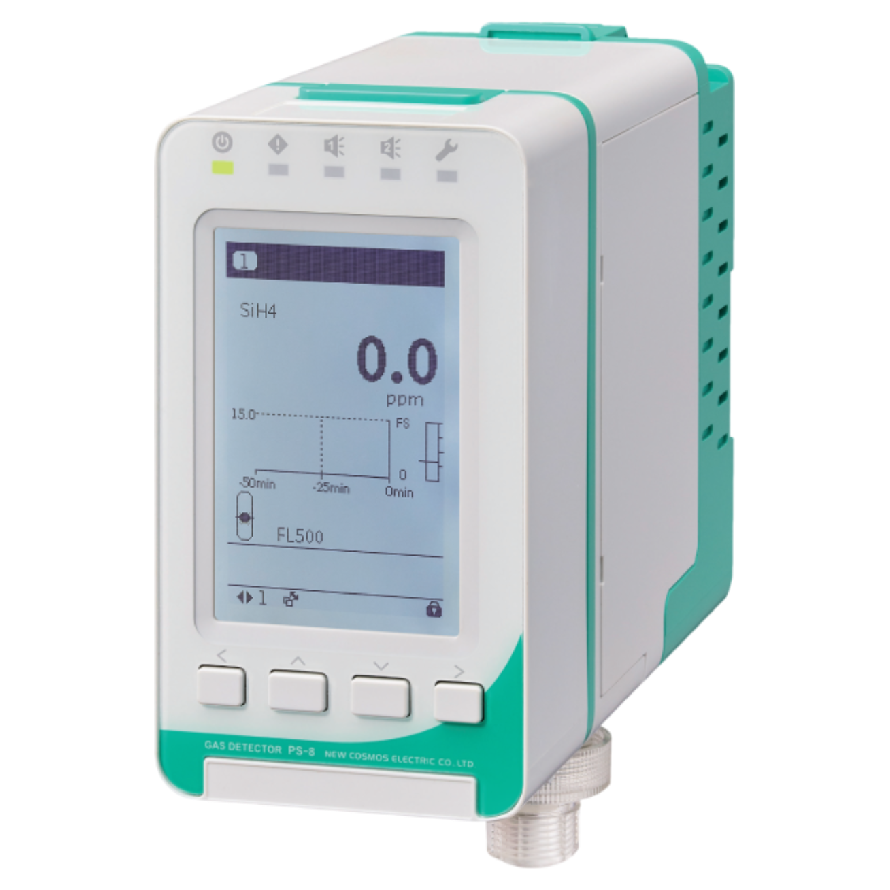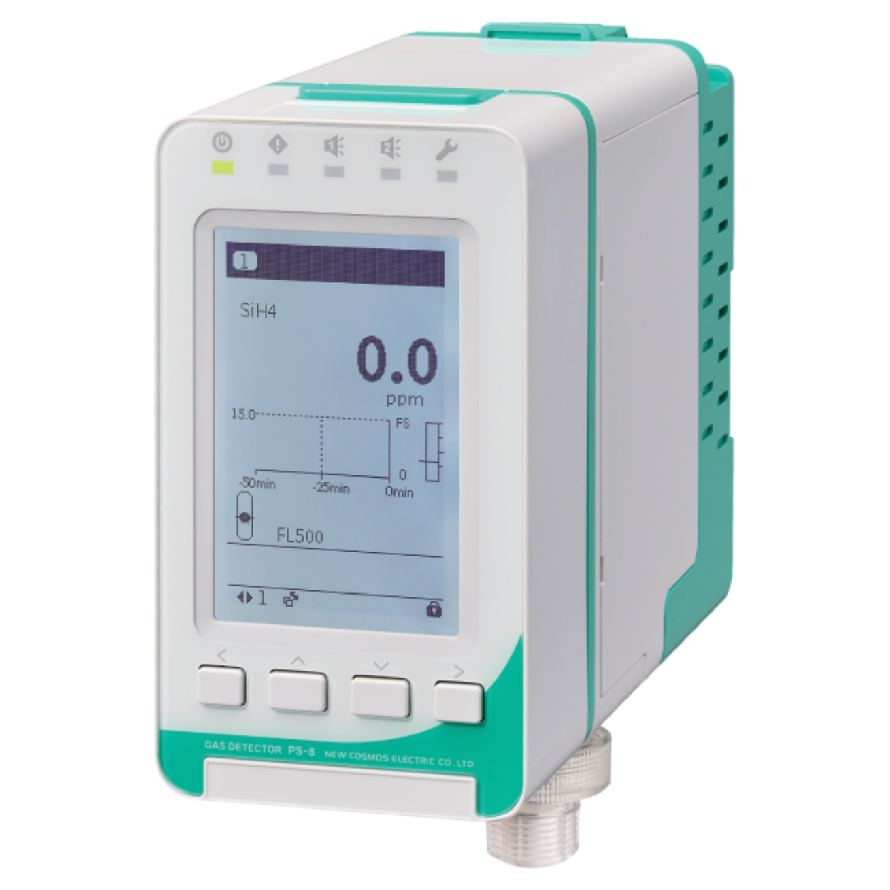
Specification
Model
Main unit: PS-8N, PS-8M
Sub unit: PS-8S
Target Gases
Potentiostatic electrolysis type: depends on specific specifications
Hot-wire semiconductor type: combustible gas (hydrogen, methane, etc.)
Galvanic cell type: oxygen
Detection Principle
Potentiostatic electrolysis type, hot-wire semiconductor type, membrane galvanic cell type
Sampling Method
Pump suction type (approx. 0.5L/min±20% automatic suction flow control)
Detection Range
Combustible gas (hydrogen, methane, etc.): 0~2000ppm
Oxygen: 0~25 vol%
Alarm Method
Gas concentration is displayed on a monochrome LCD full dot matrix with 5 digits (with unit)
Alarm Setpoint
According to purchased specifications
Alarm Accuracy
Combustible gas: ±25% of alarm set value under the same conditions
Toxic gas: ±30% of alarm set value under the same conditions
Oxygen deficiency: ±1 vol% under the same conditions
Alarm Delay
Combustible gas: gas at 1.6 times the alarm set value → delay within 30 sec
Toxic gas: gas at 1.6 times the alarm set value → delay within 60 sec
Oxygen deficiency: when concentration goes from 10 vol% to 18 vol% → delay within 5 sec (20±2 ℃)
(The above times do not include piping length and communication time)
Alarm Indication
Stage 1: Alarm 1 LED flashes red, screen displays ALARM1
Stage 2: Alarm 2 LED flashes red, screen displays ALARM2
External Output
[Digital signal] ※Limited to Ethernet or expansion module Modbus-RTU
- PS-8M: Ethernet 10BASE-T/100base-Tx (Modbus/TCP)
Modbus/TCP (number of connectable devices depends on system configuration)
Max. transmission distance 100m (up to HUB)
- PS-8N, PS-8S: None
*PS-8N can use MR expansion module RS485 (Modbus-RTU)
[Gas concentration analog signal]
- PS-8N, PS-8M: DC4-20mA (common with power supply negative) (output accuracy: within FS±0.5%)
* Output signal drops to 0.6mA or below when a fault alarm occurs
*Load resistance including wiring resistance must be 300Ω or below
[Gas alarm contacts (stages 1 and 2), fault alarm contact]
1a voltage-free contact/auto reset
*Rated load AC125V 0.5A or DC30V 1.0A (resistive load)
*Independent contact output requires an expansion module
Explosion-Proof Performance
Non-explosion-proof
Operating Temperature and Humidity Range
0°C to 40°C (no drastic temperature change), 30 to 85% RH (non-condensing)
Power Supply
PS-8N: DC24V±10%
PS-8M: DC24V±10% or PoE (Power over Ethernet, IEEE 802.3at)
PS-8S: Supplied by main unit
Power Consumption
CDS-7: 3.5W (max. 5.2W)
CDS-7 (catalytic conversion type): 4.0W (max. 5.9W)
COS-7: 3.5W (max. 5.2W)
CHS-7: 4.0W (max. 5.9W)
※Using analog output and digital output at the same time will increase power consumption.
Dimensions
W70mm×H124mm×D172mm (excluding protrusions)
Weight
PS-8N, PS-8M: Approx. 850g (excluding sensor)
PS-8S: Approx. 770g (excluding sensor unit)
Product Features
| Gas Detection Equipment for Semiconductor Plants
| Uses the "New COSMOS Method※" to replace and calibrate sensors
| Unique hot-wire semiconductor-type hydride sensor offers a longer service life
| Equipped with a large LCD display for an at-a-glance view of on-site conditions
| Supports PoE to reduce wiring, with seamless PLC connection to simplify data transmission
| Front-opening design for easy sensor replacement
| Install sub-units/expansion modules to connect multiple sensors according to the gases to be detected and their quantity※COSMOS-Type
In 1997, on-site gas calibration at the installation location was abandoned in favor of collecting sensors for calibration, reducing the company's operating costs.